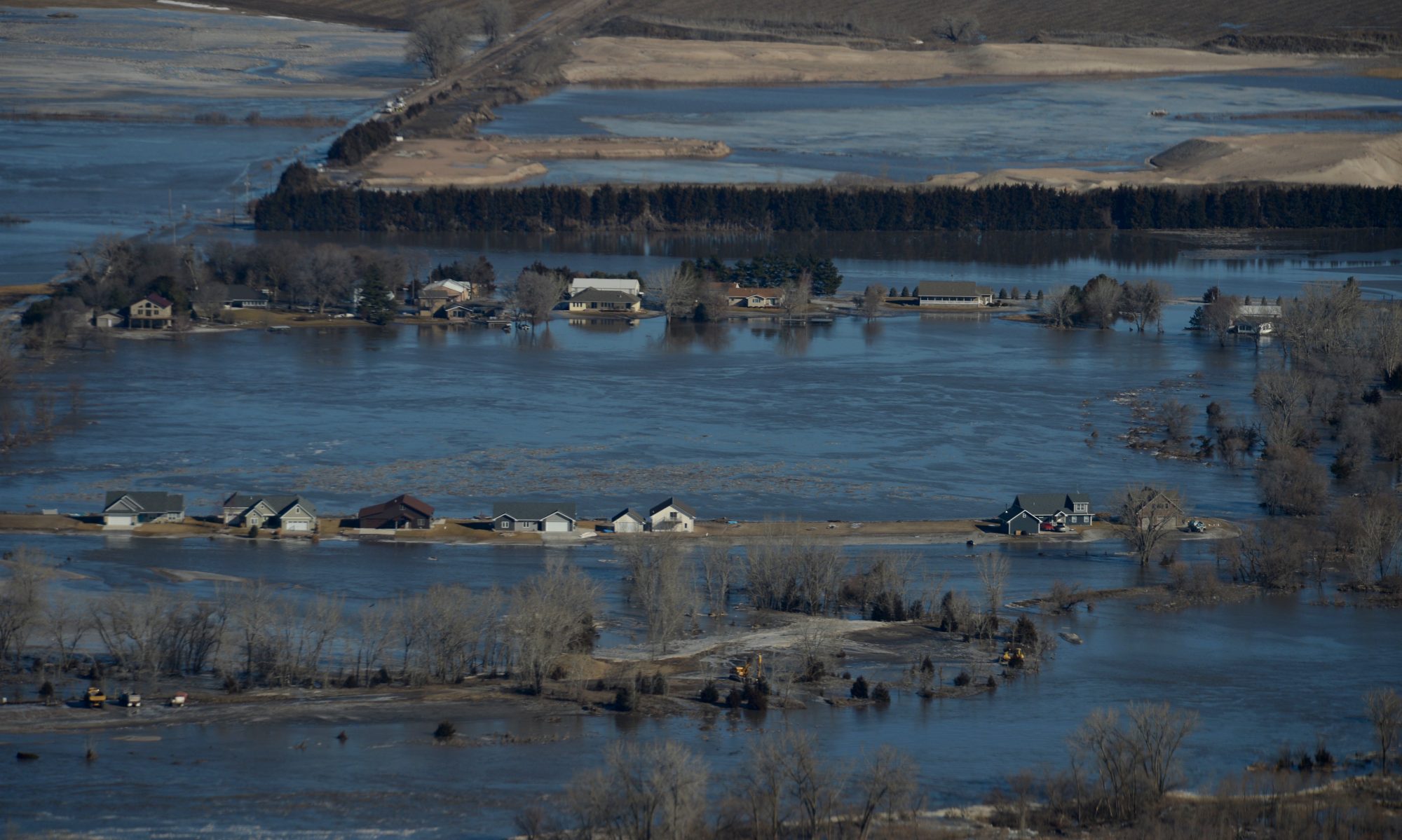

Nebraska National Guard Chief Warrant Officer 5 Jeff Caniglia will always look back on the historic floods of 2019 as “life changing” and one of his proudest moments.
In October 2020 – a year and half after the historic floods of 2019 – Caniglia, Nebraska National Guard deputy state aviation officer, reflected on the Guard’s response and the top lessons learned.
Of all the assistance the Nebraska National Guard aviators provided – from hoist rescues, to aerial reconnaissance, and sandbagging support to literally dropping hay to stranded livestock – Caniglia said it was having developed relationships and partnerships outside of the organization that made the response successful for Nebraska.
“From the floods to COVID…I don’t think it’s gonna stop,” Caniglia said. “So we need to keep developing those relationships… because it is a partnership and we’re seeing that more and more now for our responses on a nationwide basis.”
The response to the 2019 floods was the largest helicopter response ever in Nebraska from the Army’s perspective.
“We used the entire fleet,” Caniglia said, “everything we had.”
Caniglia said the long hours and the high-risk nature of those initial missions made the response a deployment for many of the aviators involved. And he is extremely proud of how the crews immediately jumped to action.
“We’re not a 911-type of service,” he said. “We don’t sit postured, ready to go for any type of emergency.”
Caniglia said it normally takes 24-48 hours to respond to larger events, such as hurricanes or wildfires, which is why pre-planning and early anticipation requests for assistance are important.
“Once the Spencer Dam broke, it was an immediate life, limb or eyesight type of response,” he said, and first aviation rescue crews were out the door in less than three hours.
This was also the first time many of the Soldiers involved were responding in their home state. They may have supported other states and completed aerial rescues during flooding caused by hurricanes, or rescues during combat situations, but never before had people’s lives been on the line like this in Nebraska.
In total, the Nebraska National Guard would perform 112 rescues, including 66 hoist rescues – more hoist rescues than on any previous hurricane response. The Nebraska National Guard would also help distribute more than 60 tons of hay to stranded livestock, including writing the standard operating procedures for delivering a “non-standard load” of 2 ton round hay bales by dropping them out the back of an active CH 47-Chinook helicopter.
“It was extremely fulfilling to help our neighbors,” Caniglia said. “I’ve done a lot of flying in the years, multiple combat missions and those kinds of things… but when you make an impact on your own community, or you save lives within your own community… that’s why we join. That’s why we’re part of the Guard. That’s the Guard’s mission, is to be there for our community; to be there for our neighbors. And we were there.”

On Mar. 14, 2019, the initial launch of the aviation rescue helicopters was to answer a distress call to find and extract an elderly, wheelchair bound woman trapped within her flooded home. Unfortunately, due to the high winds, rapid floodwaters, ice chunks, powerlines, trees and more, the Nebraska National Guard helicopter couldn’t reach her – and neither could the swift-water rescue crews from Task Force One, an urban search and rescue team sponsored by the Federal Emergency Management Agency (FEMA).
Following the floods, the Nebraska National Guard and Task Force One partnered together to create a new program called the Nebraska Helicopter Search and Rescue Team (NE-HSART).
“With that unfortunate loss of life, we found a new program, and that Nebraska HSART program will serve Nebraska,” Canigilia said.
The program will also serve when responding to other disasters across the country, as trained rescue technicians with extraction expertise and others with the HSART can embed with the combat helicopter crews to make for more capable rescue and response efforts.
The Nebraska National Guard has also expanded training plans with multiple partners including first responders, EMS, firefighters and local hospitals. Post-flood response, the Nebraska National Guard, Task Force One and other first responders conduct quarterly training exercises. One of the largest training exercises was Operation Titan Fall, a multi-agency domestic response exercise held on Oct. 19, 2019, in Lincoln.
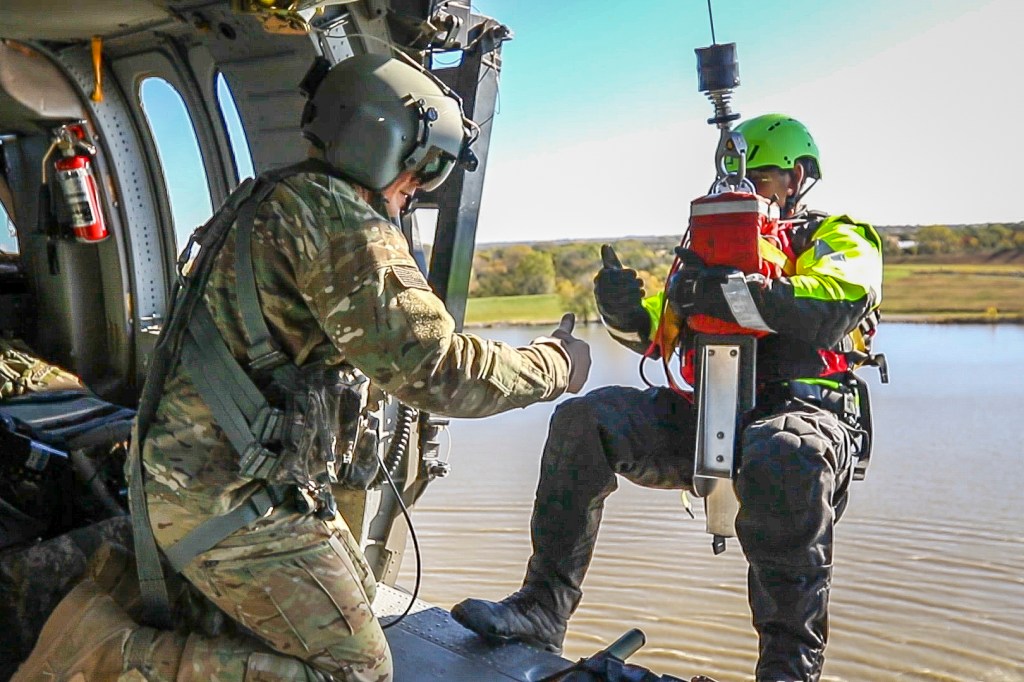
Operation Titan Fall was designed to test and improve emergency procedures and communication between multiple organizations, as well as local civil authorities and first responders. During the exercise, Nebraska National Guard aviators assisted Task Force One firefighters in extracting simulated victims from Stagecoach Lake using hoist capabilities, and transporting them to nearby CHI Health Saint Elizabeth hospital.
“The first time that they’re getting on a hoist should not be the night their lives are at risk,” Caniglia said, referring to the seven firefighters pulled from the water after their boat capsized responding during the 2019 floods.
Caniglia said the expanded partnership cross-training and the NE-HSART program has increased the Nebraska National Guard’s overall readiness, and is invaluable for preparing for future disaster response.
“We’re way more prepared to respond than we have been in the past,” he said.
For more reflections by Chief Warrant Officer 5 Jeff Caniglia, watch his full interview here:
 Good Life, Great Strength